
B2B SEO for regulated medical technology
B2B SEO services for the MedTech sector, built for six buyers and an eighteen-month cycle
Standard B2B SEO fails here for one reason: it writes for a single buyer. Your purchase involves a clinician, a CFO, an IT director, a procurement officer, a regulatory lead and a value analysis committee — each running a separate search, at the same time, for a year and a half.
- Keyword architecture mapped to all six personas, not one
- Content cleared against FDA promotional labeling before publication
- YMYL E-E-A-T built in — named clinical authorship, cited evidence, verifiable credentials
- GEO layer so you get cited when a VP of Clinical Engineering asks an AI, not a search box
Same content-driven system that produced +5,600% organic growth from zero domain authority,
then took eight brands to page one across separate industries.
Get your free SEO audit · See all B2B SEO solutions
Get your MedTech SEO blueprint
Keyword gap analysis against your top five competitors, a buyer-journey coverage audit and a 90-day roadmap for your category. One business day. No sales call.
Why generic B2B SEO fails here
Three constraints that exist in no other B2B sector
The opportunity inside MedTech B2B SEO is real, but the constraints are unlike anything else. A claim that is unremarkable on a software company’s site can trigger an FDA enforcement action when a device manufacturer makes it. A keyword approach that works beautifully for SaaS fails systematically when the buyers are clinical, financial, technical and regulatory — all at once, all on different timelines.
Google’s highest content standard applies to every page
Medical technology sits squarely inside Your Money or Your Life, so quality raters apply the strictest E-E-A-T criteria sitewide. Thin content, anonymous authorship or unreviewed AI copy does not simply fail to rank — it suppresses domain authority across every keyword category you already hold.
Promotional content is regulated before it is published
Device promotional content falls under 21 CFR Part 801 and related guidance. Uncleared efficacy claims, implied indications beyond a 510(k) or PMA, or unqualified off-label use cases create real exposure. Content gets reviewed before it goes live, not after a warning letter arrives.
Six people have to say yes, and they search differently
Clinical, economic, technical, procurement, regulatory, and the value analysis committee. Each searches different terms, reads different formats and needs different questions answered before the evaluation advances at all. A site that addresses only the clinician is speaking to one sixth of the room.
Buyer journey architecture
Six stakeholders. Six keyword clusters. One purchase order.
Clinical buyer
Physician or department head evaluating clinical utility. Wants outcomes data, comparative effectiveness and peer-reviewed validation.
outcomes data [device]clinical evidence [technology]
peer comparison
Economic buyer
CFO or VP Finance weighing total cost of ownership and reimbursement impact. Wants ROI models and budget justification, not feature lists.
roi of [device category]reimbursement codes
cost per procedure
Technical buyer
IT director or biomedical engineer checking integration and interoperability. Needs HL7, FHIR and security answers in indexed HTML, not a PDF.
hl7 integrationfhir compatible
hipaa compliant [solution]
Procurement officer
Runs vendor qualification and contract terms. Searches certifications and GPO contract status explicitly during the qualification stage.
iso 13485 certifiedvendor qualification
gpo contract
Regulatory affairs
Verifies clearance status, CE marking, IEC compliance and post-market surveillance before the deal can progress at all.
510k cleared [device]ce marked
mdr compliant
Value analysis committee
The cross-functional gate on capital purchases above threshold. Requires evidence summaries, competitive analysis and peer institution references.
competitive comparisonimplementation case study
peer institution data
The content system
Seven content types that actually rank in a regulated sector
The B2B SEO strategy that works for a surgical robotics company is structurally different from one built for digital health SaaS. Most MedTech companies fail in one of two directions: thin marketing copy that makes claims without evidence, or dense clinical white papers that are accurate but structurally invisible to search. What produces pipeline sits precisely between the two.
Evidence synthesis posts
4,500+ word authority pieces synthesising published clinical evidence around a technology category, with named author credentials and academic-standard citations. The backbone of MedTech topical authority.
Regulatory status pages
510(k) number, cleared indications, device classification, CE marking, ISO certifications — with schema markup and linked FDA database entries. Among the highest-converting pages in the sector.
Integration & technical specs
HL7, FHIR, NIST and HITRUST answers moved out of unindexable PDFs into optimised HTML, so the IT buyer finds you rather than the competitor who published theirs properly.
Health system case studies
Structured around institution type, technology category and specialty, focused on institutional metrics rather than patient-specific outcomes — publishable without creating HIPAA exposure.
ROI and TCO calculators
Interactive tools letting the economic buyer model procedure volume against device cost. Highest engagement format in MedTech B2B, and one of the least competitive SEO opportunities in the sector.
Competitive comparison content
Value analysis committees require competitive documentation. Publishing evidence-based comparisons captures decision-stage queries and hands the VAC exactly what it needs from a preferred vendor.
KOL thought leadership
Content authored by credentialed clinical experts carries the strongest E-E-A-T signal available in MedTech, and earns links from medical association publications and conference proceedings no outreach campaign replicates.
PDF to HTML migration
Most MedTech companies keep clinical summaries and specifications in PDFs that search engines cannot rank and AI crawlers cannot read. Migrating them is usually the single highest-impact technical action available.
AI search — the round you can’t see
Your buyers are asking AI about you before your CRM knows they exist
A health system’s VP of Clinical Engineering is asking ChatGPT, Perplexity or Gemini about technology categories and vendor comparisons weeks before anyone fills in a form. McKinsey puts AI usage among B2B buyers above 50%. If AI systems do not cite you in response to those queries, you are eliminated in a round your sales team never sees happening.
The GEO layer covers four things. Structured FAQ content answering what buyers actually ask AI, in citable question-and-answer form. Entity clarity connecting your Organization, Product and MedicalDevice schema into one coherent knowledge graph. Distributed third-party citation across medical trade publications and clinical society sites that AI systems already index. And AI-readable formats, because gated PDFs and JavaScript-rendered content are invisible to the crawlers doing the citing.
Strategy by category
Eight MedTech subsectors, eight distinct approaches
| Subsector | Primary keyword patterns | Content that moves it | Complexity |
|---|---|---|---|
| Surgical robotics | surgical robot hospital, robotic surgery system comparison | Clinical outcomes, OR workflow case studies, surgeon training | Very high |
| Capital devices | [category] system hospital, fda cleared [device], vendor comparison | Regulatory status pages, evidence synthesis, ROI calculators | High |
| Diagnostics / IVD | laboratory analyzer, ivd platform comparison, clia waived | Technical specs, CLIA status, lab workflow integration | High |
| Digital health | remote patient monitoring platform, digital health ehr integration | IT integration pages, HIPAA docs, API documentation | Med-high |
| Wearables | medical grade wearable b2b, continuous monitoring platform | FDA clearance pages, clinical validation, enterprise integration | Medium |
| Telehealth | telehealth platform hospital, virtual care platform ehr | HIPAA compliance, reimbursement guidance, workflow content | Medium |
| Clinical lab / LIS | laboratory information system, lis ehr integration | HL7 specs, compliance pages, lab director case studies | High |
| Clinical AI / SaMD | clinical ai platform, medical imaging ai, ai-assisted diagnosis | SaMD clearance pages, algorithm validation, pilot data | Very high |
Transparent pricing
What MedTech B2B SEO costs, published before you call
MedTech runs higher than standard B2B SEO services because of regulatory content review, multi-persona architecture and YMYL implementation. An agency quoting standard rates has not priced those in, and will either under-deliver or expand scope mid-engagement.
- Full technical and content audit
- Keyword universe across all six personas
- Four authority posts monthly
- Complete schema stack
- Monthly reporting
- Everything in Foundation
- Eight posts monthly
- Multi-persona content architecture
- Link building and digital PR
- Full GEO / AI search optimisation
- Everything in Authority
- KOL content programme
- VAC content architecture
- Competitive displacement strategy
- Enterprise reporting cadence
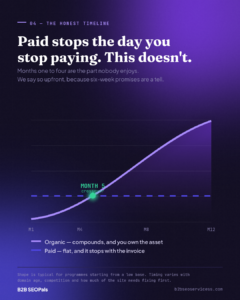
TIMELINE BENCHMARKS — first ranking movement months 3–4 · meaningful organic lead flow months 6–9 · compounding growth months 9–12
Ranges reflect scope, not guarantees. Outcomes depend on domain history, competition and current site condition.
Questions
MedTech B2B SEO, answered
What is B2B SEO for the MedTech sector?
Optimising a medical technology company’s site and content to rank for the terms MedTech buyers use during a six to eighteen month evaluation — across clinical, economic, technical, procurement, regulatory and value analysis stakeholders. It requires YMYL E-E-A-T compliance, FDA promotional content review, HIPAA-aware handling and a multi-persona keyword architecture standard B2B SEO does not address.
How is it different from standard B2B SEO?
Three things. Every content piece is reviewed against FDA promotional labeling standards before publication. Six distinct buyer personas search separate keyword clusters simultaneously, rather than one champion driving a purchase. And the cycle runs six to eighteen months, which means top, middle and bottom funnel content all have to exist at once rather than sequentially.
How long before it produces results?
Initial ranking movement typically appears in months three to four, usually in lower-competition clusters like regulatory status and integration specification queries. Qualified inbound from procurement committees or clinical department heads generally begins at six to nine months. Compounding growth — where each month produces more pipeline than the last — activates around months nine to twelve.
What is YMYL and why does it matter here?
Your Money or Your Life is Google’s designation for content that could materially affect health, safety or financial wellbeing. Medical technology content is definitionally YMYL, so quality raters apply the strictest E-E-A-T criteria to every page. Content without named expert authors, cited evidence and verifiable organisational credentials will not rank for competitive MedTech terms regardless of how well it is technically optimised.
How does FDA compliance affect the content?
FDA rules on device promotional content apply to website content making product claims. Content must accurately represent cleared indications, avoid superiority claims without clinical evidence, and not promote off-label use in a promotional context. The workflow that works separates educational content explaining how a technology category works from commercial content making claims about a specific product, with the latter reviewed against current cleared labeling before it publishes.
Why does GEO matter for MedTech specifically?
Because MedTech buyers are among the heaviest AI search users — the research complexity of clinical and procurement decisions is exactly what AI synthesis is good at. McKinsey puts AI tool usage above 50% among B2B buyers evaluating solutions pre-sales. Companies AI systems do not cite in response to category queries are removed from shortlists in a round that never appears in the CRM.
Which subsectors get the most from SEO?
The highest return comes where the buying process is self-directed and research-intensive, where competitor content is thin relative to deal value, and where the cycle is long enough that content influences several stages before sales engagement. Surgical robotics, medical imaging AI and health system clinical software are particularly strong in 2026 — high deal values against unusually weak competitor content.
How do we start?
With an audit mapping your current organic presence against the keyword universe your buyers actually search, across all six personas and all four intent stages. That comparison shows exactly where the gaps sit between what you rank for and what your buyers need to find. Submit the form at the top of this page, or request a free SEO audit directly. Either comes back within one business day, with no call required.
Other B2B SEO use cases
SEO built for other B2B verticals
B2B Ecommerce SEO
Catalogue architecture, faceted navigation and bulk-order intent for distributors and manufacturers selling online.
B2B Healthcare SEO
The wider healthcare vertical — payers, providers and health services operating under the same YMYL scrutiny.
B2B SEO Consulting
Strategy, audit and roadmap engagements for teams that have execution capacity but need the direction.
B2B Service Provider SEO
Effective strategies for professional services firms with long cycles and committee-led buying.
b2b seo services for the medtech sector · medtech sector b2b seo services · b2b seo services · b2b seo service · b2b seo use cases
The competitive window in MedTech search is open right now
Most MedTech companies are still publishing in formats search engines cannot index, authored anonymously in ways that fail YMYL, or structured for the wrong audience entirely. The gap between what the sector publishes and what Google and AI systems require has never been wider — which is the entire opportunity.
Get your free MedTech SEO blueprintOr email info.seopals@gmail.com
B2B SEO Services for the MedTech Sector: The Complete 2026 Strategy Guide
The medical technology sector operates under constraints that make most standard B2B SEO advice not just insufficient — but actively dangerous. A content claim that would be unremarkable on a software company’s website can trigger an FDA enforcement action when made by a medical device manufacturer. A keyword targeting approach that works beautifully for a SaaS company will fail systematically in a sector where the buyers are clinical decision-makers, procurement committees, hospital value analysis boards, and regulatory affairs teams all moving through separate research tracks simultaneously.
And yet the opportunity hiding inside MedTech B2B SEO is extraordinary. The global MedTech market exceeds $500 billion and is growing at 5 to 7 percent annually. B2B buyers in this sector — from hospital systems evaluating surgical robotics platforms to diagnostic lab directors researching next-generation sequencing equipment — conduct extensive independent research before engaging a sales team. Research from Forrester confirms that 68% of B2B buyers prefer to do their own research online before engaging sales. In MedTech, that percentage is higher because the clinical and regulatory stakes of a wrong vendor decision are severe.
This guide provides the most comprehensive publicly available framework for b2b seo services for the medtech sector — covering YMYL compliance, FDA content constraints, multi-stakeholder buyer journey mapping, MedTech-specific keyword architecture, technical SEO for regulated industries, and the GEO and AI search optimization layer that is now reshaping how MedTech buyers discover vendors before a human is ever involved. The system described here is the same content-driven SEO methodology deployed by B2B SEO Services— the agency that grew a brand 5,600% using documented content depth over domain age, then replicated the system across 8 brands in different industries. After this blog you won’t be looking for B2B Seo Services for the Medtech Sector, We have you covered, Get Your Free SEO Audit today!
KEY MEDTECH B2B SEO STATISTICS — 2026
$500B+ Global MedTech market size — one of the highest-value B2B sectors for organic search investment
68% of B2B buyers complete independent online research before engaging any vendor (Forrester)
50%+ of B2B buyers now use AI tools (ChatGPT, Gemini, Perplexity) to evaluate MedTech solutions (McKinsey)
6–18 months Typical MedTech B2B buying cycle — longer than almost any other B2B sector
6–12 months Time to meaningful organic lead generation for medical device SEO with a documented system
YMYL Google’s highest content quality standard applies to all MedTech content — E-E-A-T is mandatory
30–50% of enterprise B2B decision journeys expected to be AI-influenced by 2026 (industry research)
WHY MEDTECH B2B SEO IS A DIFFERENT GAME
Why B2B SEO Services for the MedTech Sector Require a Fundamentally Different Approach
Most B2B SEO frameworks assume a relatively forgiving operating environment: an agency can test content approaches, iterate quickly, and optimize based on traffic data without worrying about regulatory implications. MedTech does not offer that environment. Every piece of content your MedTech company publishes is subject to three layers of constraint that do not exist in any other B2B sector.
The first layer is Google’s YMYL standard. Your Money or Your Life is Google’s designation for content that could materially affect a reader’s health, safety, financial wellbeing, or major life decisions. Medical technology content falls squarely within YMYL, which means Google’s quality raters apply the strictest E-E-A-T criteria — Experience, Expertise, Authoritativeness, and Trustworthiness — to every page on your site. A thin content approach, generic blog posts, or AI-generated copy published without expert review will not just fail to rank in MedTech SEO. It will actively suppress your entire domain’s authority across all keyword categories.
The second layer is FDA and regulatory content compliance. Medical device companies selling in the United States are bound by FDA regulations governing promotional labeling and advertising claims. Content that makes uncleared efficacy claims, implies indications beyond a device’s 510(k) clearance or PMA approval, or presents off-label use cases without appropriate qualification can trigger regulatory enforcement. Your SEO content strategy must be reviewed against regulatory standards before publication — not after a warning letter arrives.
The third layer is the complexity of the MedTech buyer. In most B2B sectors, you are writing for one or two buyer personas. In MedTech, a single purchase decision involves a clinical buyer (physician, clinical engineer, or department head who evaluates clinical utility), an economic buyer (CFO or VP of Finance evaluating total cost of ownership and reimbursement impact), a technical buyer (IT director or biomedical engineer evaluating integration and interoperability), a procurement officer managing vendor qualification and contract terms, and often a regulatory affairs team verifying compliance. Each persona searches different keywords, reads different content types, and needs different questions answered before they will advance the evaluation.
YMYL COMPLIANCE STANDARD Every MedTech B2B content piece must demonstrate Experience, Expertise, Authoritativeness, and Trustworthiness at the page level — named authors with credentials, cited clinical evidence, and language calibrated against FDA promotional content guidelines. Generic content published without these signals will not rank and may harm the domain.
THE MEDTECH B2B BUYER JOURNEY
Mapping the MedTech Buyer Journey: Six Stakeholders, Eighteen Months, One Purchase
The MedTech B2B buying cycle is the most complex in any industry that uses organic search as a primary discovery channel. Unlike SaaS, where a champion can often accelerate a purchase to 30 to 90 days with a free trial, MedTech deals involving capital equipment, regulated devices, or clinical software routinely take 6 to 18 months from initial awareness to signed purchase order. Understanding the search behavior at each stage of this journey is the foundational work that determines whether your SEO program generates pipeline or just traffic.
The Six MedTech Buyer Personas and Their Search Behavior
- Clinical Buyer (Physician / Department Head): Searches clinical evidence terms, outcomes data, comparative effectiveness, and peer-reviewed validation. Keywords: ‘outcomes data [device category],’ ‘clinical evidence [technology name],’ ‘peer comparison [competitor vs. brand].’ Content needed: white papers, clinical summaries, KOL endorsements.
- Economic Buyer (CFO / VP Finance / C-Suite): Searches total cost of ownership, reimbursement impact, ROI, and budget justification content. Keywords: ‘roi of [device category],’ ‘reimbursement codes [procedure],’ ‘cost per procedure [technology].’ Content needed: ROI calculators, TCO analyses, budget justification frameworks.
- Technical Buyer (IT Director / Biomedical Engineer): Searches integration requirements, interoperability standards (HL7, FHIR), cybersecurity compliance, and implementation specifications. Keywords: ‘hl7 integration [device category],’ ‘fhir compatible [software],’ ‘hipaa compliant [solution type].’ Content needed: technical specification pages, integration documentation, security white papers.
- Procurement Officer: Searches vendor qualification criteria, supplier audits, ISO certifications, and contract terms. Keywords: ‘iso 13485 certified [category],’ ‘vendor qualification medical device,’ ‘gpo contract medical equipment.’ Content needed: compliance certifications page, vendor qualification documentation, GPO contract information.
- Regulatory Affairs: Searches FDA clearance status, CE marking, IEC standards compliance, and post-market surveillance requirements. Keywords: ‘510k cleared [device],’ ‘ce marked [product category],’ ‘mdr compliant [solution].’ Content needed: regulatory status pages, compliance documentation, post-market surveillance policies.
- Hospital Value Analysis Committee (VAC): The cross-functional committee that reviews all capital equipment purchases above threshold. Searches evidence summaries, competitive analyses, and implementation case studies. Content needed: VAC presentation templates, competitive comparison summaries, peer institution reference data.
CONTENT ARCHITECTURE INSIGHT A MedTech B2B website that only addresses the clinical buyer will capture only one-sixth of the decision-making audience. Content architecture for MedTech SEO must explicitly map to all six buyer personas with dedicated content clusters, landing pages, and keyword targets for each stakeholder — because each one is running a separate research process simultaneously.
YMYL, E-E-A-T, AND FDA COMPLIANCE
The Regulatory Content Framework: YMYL, E-E-A-T, and FDA Compliance for MedTech SEO
There is no B2B sector where the intersection of regulatory compliance and SEO content strategy is more consequential than MedTech. Getting this framework wrong does not just mean poor rankings — it creates legal liability. Getting it right creates an unassailable competitive advantage, because most MedTech companies either ignore the regulatory layer entirely or become so conservative that they publish nothing useful.
Google’s YMYL Standard in MedTech B2B
YMYL content receives Google’s highest scrutiny under the Quality Rater Guidelines. For MedTech B2B content, every page must demonstrate: named authorship with verifiable professional credentials (MD, PhD, PE, Regulatory Affairs Certified), citations to peer-reviewed clinical literature or FDA-cleared evidence bases, organizational trust signals including ISO certifications, FDA registration numbers, and accreditation listings, and technical accuracy verified against current product labeling and cleared indications. Content that fails any of these signals is actively downgraded in rankings regardless of keyword optimization quality. A perfectly optimized page with anonymous authorship will lose to a modestly optimized page with a named clinical author and cited evidence every time in YMYL search.
FDA Promotional Content Constraints for SEO
FDA regulates promotional content for medical devices under 21 CFR Part 801 (labeling) and related guidance. SEO content that qualifies as promotional must accurately represent cleared indications, cannot imply superiority claims without supporting clinical evidence, and cannot promote off-label uses in a promotional context. The practical application for SEO content: every product page, comparison page, and use-case article must be reviewed against the device’s cleared labeling before publication. The safest content framework for SEO purposes separates educational content (explaining how a technology category works, published as genuinely neutral information) from commercial content (making claims about a specific product’s performance, which triggers full regulatory review).
The HIPAA Dimension of MedTech SEO Content
Content featuring case studies, patient outcomes, or institutional references requires HIPAA compliance review before publication. Case studies that name patients or present identifiable health information without proper authorization expose the company to OCR enforcement. The SEO-friendly approach: focus case studies on institutional metrics (procedure volumes, workflow efficiency improvements, staff adoption rates) rather than patient-specific outcomes, and ensure all forms and tracking tools on the MedTech website are HIPAA-compliant encrypted implementations.
E-E-A-T IMPLEMENTATION CHECKLIST
Named author with credentials on every content piece. Organizational credentials (FDA registration, ISO 13485, CE notified body) displayed in site footer. Citations to peer-reviewed literature in clinical content. Post-publication date prominently displayed with last-reviewed date. Medical/regulatory review confirmation badge on product claim pages. These are not optional enhancements — they are ranking prerequisites for MedTech YMYL content.
MEDTECH B2B KEYWORD RESEARCH
MedTech B2B Keyword Research: Separating Clinical Intent from Commercial Intent
The single most common failure mode in MedTech B2B keyword research is conflating clinical intent with commercial intent. These are not the same search. A clinical buyer searching ‘minimally invasive spine surgery outcomes’ is conducting academic research — they are not ready to evaluate vendors. A procurement officer searching ‘spine surgery system vendor qualification requirements’ is deep in the commercial process. Ranking for the first without also ranking for the second generates traffic with no pipeline impact.
The Four Intent Stages for MedTech B2B Keywords
- Clinical Awareness (Top of Funnel): Technology category education, clinical evidence summaries, procedure outcomes research. Examples: ‘robotic-assisted surgery clinical outcomes,’ ‘continuous glucose monitoring accuracy comparison,’ ‘ai diagnostics radiology performance.’ High volume, long conversion path, builds authority.
- Technical Evaluation (Middle of Funnel): Product specifications, integration requirements, standards compliance, competitive comparisons. Examples: ‘ehr integrated patient monitoring systems,’ ‘fda cleared ai diagnostic platform,’ ‘510k cleared surgical robot comparison.’ Medium volume, 3–6 month conversion window.
- Commercial Consideration (Bottom of Funnel): Pricing, procurement process, vendor qualification, ROI. Examples: ‘surgical robot cost hospital,’ ‘medical device vendor qualification process,’ ‘patient monitoring system pricing enterprise.’ Low volume, high intent, direct pipeline impact.
- Decision Stage (High Intent): Specific product comparisons, implementation case studies, reference customer content. Examples: ‘[Brand A] vs [Brand B] surgical system,’ ‘[Company] 510k clearance status,’ ‘[Product] hospital implementation case study.’ Lowest volume, highest buyer intent.
The keyword universe for a MedTech B2B company in a single device category typically spans 400 to 800 terms across all four intent stages and all six buyer personas. Building this universe requires a combination of clinical terminology research (using medical databases like MeSH terms and PubMed MeSH headings as keyword sources), commercial intent research using standard SEO tools, and buyer interview intelligence — asking customers what they actually searched during their evaluation process, which often surfaces keywords no tool will ever surface.
High-Value MedTech B2B Keyword Categories
| KEYWORD CATEGORY | EXAMPLE KEYWORDS | BUYER PERSONA TARGET |
| Regulatory status | ‘510k cleared [device],’ ‘ce marked [product],’ ‘fda registered medical device’ | Regulatory Affairs, Procurement |
| Clinical evidence | ‘clinical outcomes [technology],’ ‘peer-reviewed [device category],’ ‘rct results [product]’ | Clinical Buyer, KOL |
| Integration / IT | ‘hl7 fhir compatible [solution],’ ‘ehr integration [device],’ ‘hipaa compliant [platform]’ | IT Director, Biomedical Eng |
| ROI / Cost | ‘roi [device category] hospital,’ ‘cost per procedure [technology],’ ‘reimbursement [cpt code]’ | Economic Buyer, CFO |
| Competitive | ‘[Brand A] vs [Brand B],’ ‘best [device category] 2026,’ ‘top medical device companies [vertical]’ | All Personas — Decision Stage |
| GPO / Procurement | ‘premier gpo medical device,’ ‘vizient contract [category],’ ‘vendor qualification requirements’ | Procurement Officer, Supply Chain |
| Agency search (this KW) | ‘b2b seo services medtech,’ ‘medtech seo agency,’ ‘medical device seo services’ | MedTech marketing decision-maker |
MEDTECH B2B CONTENT STRATEGY
Content Strategy for MedTech B2B SEO: The Seven Content Types That Actually Rank
Most MedTech companies produce content in one of two failure modes: either they publish thin marketing copy that makes claims without evidence (which fails YMYL standards and does not rank), or they produce dense clinical white papers that are accurate but structurally inaccessible to search engines and unreadable by non-clinical buyers. The content strategy that produces pipeline in MedTech B2B SEO occupies a precise middle ground — clinically rigorous, search-optimized, and written to serve both the clinical buyer reading for evidence and the economic buyer reading for business justification.
1. Evidence Synthesis Posts (The MedTech Pillar Content)
These are the 4,500+ word authority posts that form the backbone of MedTech B2B SEO. They synthesize published clinical evidence around a technology category — summarizing key trials, comparing clinical outcomes across device generations, and explaining the clinical decision-making framework buyers use when evaluating alternatives. The key SEO requirement: these posts must include named author credentials, literature citations formatted to academic standards, and a clear differentiation between published evidence and promotional claims. Target keywords are technology-category terms at the awareness and evaluation stages of the buyer journey.
2. Regulatory Status Pages
Dedicated pages documenting a product’s FDA clearance status (510(k) number, cleared indications, cleared device classification), CE marking status, ISO certifications, and any additional regulatory authorizations are among the highest-converting pages in MedTech B2B SEO. Procurement officers and regulatory affairs teams search these terms explicitly during vendor qualification. A well-structured regulatory status page with schema markup, linked FDA database entries, and downloadable compliance documentation can rank for regulatory intent keywords and serve as both an SEO asset and a sales enablement tool simultaneously.
3. Integration and Technical Specification Pages
IT directors and biomedical engineers searching for integration compatibility, HL7/FHIR support, cybersecurity compliance (NIST, HITRUST), and interoperability certifications need dedicated technical specification pages that answer their exact questions. Most MedTech companies bury this information in PDF data sheets that search engines cannot read. Moving integration specifications to indexed, optimized HTML pages captures the IT buyer persona’s search queries and keeps this high-intent audience on your site rather than sending them to a competitor who answered the technical question more accessibly.
4. Hospital and Health System Case Studies
Case studies structured for search — featuring the institution type (academic medical center, regional health system, independent hospital), the technology category, the clinical specialty, and specific outcome metrics — are the highest-converting MedTech B2B content format. A case study titled ‘Regional Health System Reduces ICU Alarm Fatigue 47% with AI-Assisted Patient Monitoring’ targets three different keyword clusters simultaneously: the technology category, the clinical problem, and the institution type. HIPAA-compliant case studies focused on institutional metrics (not patient-specific outcomes) can be published and optimized without triggering regulatory review.
5. ROI and Total Cost of Ownership Calculators
Interactive ROI tools embedded on the website — allowing a CFO or procurement officer to input their institution’s procedure volumes, current cost per case, and anticipated device price to calculate projected cost savings or revenue impact — are the highest-engagement content format in MedTech B2B and one of the lowest-competition SEO opportunities in the sector. Very few MedTech companies have deployed them. An ROI calculator targeted at economic buyers searching ‘cost justification for [device category]’ or ‘[technology] roi hospital’ captures high-intent commercial queries while simultaneously building trust through transparency.
6. Comparison and Competitive Intelligence Content
B2B buyers in MedTech conduct competitor comparisons as a standard part of the evaluation process. Value Analysis Committees specifically require competitive comparison documentation. Publishing transparent, evidence-based comparison content — ‘[Your Product] vs. [Competitor Product]: Clinical Evidence and Specification Comparison’ — captures buyer searches that are always high-intent commercial queries and builds the kind of credibility that VAC committees look for in a preferred vendor’s materials.
7. Thought Leadership and KOL Content
Content authored or co-authored by Key Opinion Leaders — named physicians with verifiable credentials, publication records, and institutional affiliations — carries the highest YMYL E-E-A-T signal available in MedTech SEO. A single well-structured thought leadership piece authored by a respected KOL in a clinical specialty can produce backlinks from medical association publications, clinical conference proceedings, and healthcare trade media that no agency outreach campaign can replicate. Building a KOL content program is the highest-leverage investment a MedTech company can make in its long-term SEO authority.
CONTENT CALENDAR PRINCIPLE MedTech B2B content should be published at a minimum cadence of two pieces per month at the evidence synthesis level (4,500+ words) and four shorter supporting posts monthly. Below that threshold, the topical authority signals required to rank for YMYL MedTech keywords cannot accumulate at the rate needed to outpace competitors who have been publishing consistently for years.
Technical SEO for MedTech Websites: The Foundation That Makes Everything Else Work
MedTech company websites have a specific set of technical challenges that compound the already-difficult task of ranking in a YMYL-regulated sector. The most common technical failures in MedTech B2B websites are not generic speed or crawlability issues — they are structural problems unique to how MedTech companies build and maintain their digital presence.
Schema Markup for MedTech B2B
The full schema stack for a MedTech B2B website must include Organization schema with regulatory trust signals (FDA registration number, ISO certification status, notified body references), MedicalDevice or MedicalOrganization schema where applicable, Product schema for individual device pages with regulatory status attributes, FAQPage schema for clinical FAQ content (which captures AI Overview citations), HowTo schema for procedure preparation and workflow content, and BreadcrumbList schema across the full site architecture. MedTech companies that deploy this full schema stack gain significant AI Overview citation advantage over competitors whose pages lack structured data — and AI citation probability in MedTech search queries is growing faster than in any other B2B vertical.
PDF to HTML Migration
The single most impactful technical SEO action most MedTech companies can take is migrating their content from PDFs — where 80 to 90 percent of MedTech companies store their clinical summaries, product brochures, technical specifications, and case studies — to indexed HTML pages. Search engines cannot reliably index PDFs at the same authority level as HTML content. A clinical evidence summary that has been downloaded 10,000 times as a PDF is generating zero direct organic rankings. Converted to an optimized HTML page with proper schema, author attribution, and internal linking, that same content can rank for clinical intent keywords within 60 to 90 days.
Core Web Vitals and Page Experience
MedTech websites are disproportionately affected by Core Web Vitals failures because they tend to be built on enterprise CMS platforms (Sitecore, Drupal, Veeva) that are optimized for compliance management rather than page performance. LCP (Largest Contentful Paint) targets above 2.5 seconds are common in MedTech, driven by heavy asset loading from product images, device videos, and compliance-heavy JavaScript. Technical SEO for MedTech requires not just standard optimization but working within the constraints of regulated platform environments where certain modifications require change control processes.
Duplicate Content from Regulatory Filing Language
A specific MedTech SEO technical issue: product pages that reproduce verbatim language from 510(k) submissions, FDA labeling, or regulatory filings often create duplicate content issues because the same regulatory language appears across multiple product pages or on external FDA database pages. The solution is to structure regulatory content as reference summaries with original contextualizing prose rather than direct reproduction of submission language, ensuring each product page has sufficient unique editorial content to be indexed as original.
GEO & AI SEARCH FOR MEDTECH
GEO and AI Search Optimization: Why MedTech B2B Buyers Are Already Using AI Before You Know They Exist
The statistic from McKinsey that over 50% of B2B buyers now use AI tools to evaluate solutions before engaging sales takes on particular significance in MedTech. A hospital’s VP of Clinical Engineering or a health system’s Director of Supply Chain is asking ChatGPT, Perplexity, or Gemini questions about technology categories, vendor comparisons, and clinical evidence — weeks or months before your CRM has a record of their existence. If your MedTech company is not cited by AI systems in response to those queries, you are being eliminated from consideration in a round your sales team does not know is happening.
AI Overviews now appear in 60%+ of US searches, and in healthcare and MedTech search queries — which involve complex technical topics where AI citations carry significant credibility weight — that percentage is higher. Visitors who arrive via AI-generated search results convert at 4.4x the rate of standard organic visitors according to documented benchmarks. For MedTech companies, where a single conversion is worth $50,000 to $5,000,000 in deal value, optimizing for AI citation is not a theoretical future concern. It is an immediate revenue opportunity.
GEO Implementation for MedTech B2B
- Structured FAQPage content: Questions that MedTech buyers ask AI systems — ‘what is the FDA clearance status of [device category],’ ‘how does [technology] integrate with Epic EHR,’ ‘what is the reimbursement pathway for [procedure]’ — must be answered in structured FAQ format with clear, citable language. AI systems prefer content that is organized as direct question-answer pairs with verifiable cited sources.
- Entity clarity signals: Your company, your products, and your technology category must be explicitly described as named entities with consistent labeling across all content. Schema markup connecting your Organization entity to your Product entities to your MedicalDevice entities creates the knowledge graph signals that allow AI systems to confidently cite your brand in response to category queries.
- Third-party citation presence: AI systems preferentially cite sources they have indexed from multiple domains. Publishing thought leadership on medical trade publications (MedCity News, Medical Device and Diagnostic Industry, Fierce Healthcare, Health IT Analytics), conference proceedings, and clinical society websites creates the distributed citation network that tells AI systems your company is a recognized authority in its category.
- AI-visible content formats: Dense PDFs, gated white papers, and JavaScript-rendered content are invisible to AI crawlers. Web-native content published as indexed HTML with clear heading structure, short answer paragraphs followed by detailed explanation, and properly structured schema is the format AI systems can reliably cite.
AI SEARCH PRIORITY In MedTech B2B, AI search is not a future channel to monitor — it is an active buyer research channel today. 50%+ of procurement committee members are using AI tools to shortlist vendors before a formal RFP is issued. GEO optimization for MedTech is the highest-urgency item in any 2026 B2B SEO services engagement for the medtech sector.
MEDTECH SUBSECTORS — SEO STRATEGY BY CATEGORY
B2B SEO Services for the MedTech Sector by Subsector: Eight Categories, Eight Distinct Approaches
The term ‘MedTech’ covers a spectrum of product and service categories that share regulatory context but differ dramatically in buyer behavior, keyword patterns, and content depth requirements. The B2B SEO strategy that works for a surgical robotics company targeting hospital OR committees is structurally different from the strategy that works for a digital health SaaS company targeting health system IT departments. Here is the differentiated approach for each major MedTech subsector.
| MEDTECH SUBSECTOR | PRIMARY KEYWORDS | KEY CONTENT TYPES | SEO COMPLEXITY |
| Surgical Robotics | ‘surgical robot hospital,’ ‘robotic surgery system comparison,’ ‘da vinci alternative’ | Clinical outcomes data, OR workflow case studies, surgeon training content | Very High — YMYL + capital equipment cycle + OR committee |
| Medical Devices (Capital) | ‘[device category] system hospital,’ ‘fda cleared [device],’ ‘[category] vendor comparison’ | Regulatory status pages, clinical evidence synthesis, ROI calculators | High — VAC process, multi-year replacement cycles |
| Diagnostics / IVD | ‘laboratory analyzer [category],’ ‘ivd platform comparison,’ ‘clia waived [test]’ | Technical spec pages, CLIA status, lab workflow integration content | High — lab director + pathologist + procurement personas |
| Digital Health / HealthTech | ‘remote patient monitoring platform,’ ‘clinical ai software,’ ‘digital health ehr integration’ | IT integration pages, HIPAA compliance docs, outcomes data, API documentation | Medium-High — SaaS cycle but YMYL requirements apply |
| Wearables / Consumer MedTech | ‘medical grade wearable b2b,’ ‘wearable health monitoring enterprise,’ ‘continuous monitoring platform’ | FDA clearance pages, clinical validation summaries, enterprise integration guides | Medium — B2B2C channel complexity |
| Telemedicine / Telehealth | ‘telehealth platform hospital,’ ‘telemedicine solution enterprise,’ ‘virtual care platform ehr’ | HIPAA compliance, reimbursement guidance, workflow integration content | Medium — accelerated by post-pandemic adoption |
| Clinical Laboratory / LIS | ‘laboratory information system,’ ‘lis ehr integration,’ ‘clinical lab software comparison’ | HL7 integration specs, regulatory compliance pages, lab director case studies | High — IT + lab director + CFO buying committee |
| MedTech SaaS (AI/ML) | ‘clinical ai platform,’ ‘medical imaging ai,’ ‘ai-assisted diagnosis software’ | FDA SaMD clearance pages, algorithm validation white papers, clinical pilot data | Very High — SaMD regulation + clinical validation requirements |
CHOOSING A B2B SEO AGENCY FOR MEDTECH
How to Choose a B2B SEO Agency for the MedTech Sector: Six Questions That Separate Experts from Generalists
The market for B2B SEO services for the medtech sector is thin. The number of agencies that understand both the technical requirements of modern SEO and the regulatory constraints of MedTech content is small. The majority of agencies that claim MedTech SEO expertise are general B2B SEO agencies that have worked with one or two healthcare clients and added ‘MedTech’ to their services page. Asking the right questions before engaging an agency protects both your SEO investment and your regulatory compliance posture.
- Can you show us a MedTech-specific case study with named client, before/after data, and documented methodology? A genuine MedTech SEO specialist can name clients (or reference them with appropriate disclosure), share organic traffic growth data, and explain the specific strategy deployed. Generic case studies showing broad healthcare traffic increases without MedTech-specific methodology are not sufficient evidence of MedTech SEO competency.
- How do you handle FDA promotional content compliance review in your content production process? The correct answer involves a defined regulatory review step before publication, either through an internal regulatory affairs team, an external regulatory consultant, or a documented content clearance framework calibrated to FDA guidance. An agency that cannot answer this question should not be producing content for a regulated medical device company.
- How do you differentiate keyword strategy for clinical versus economic versus procurement buyers? MedTech SEO without multi-persona keyword mapping is not MedTech SEO — it is generic B2B SEO with healthcare vocabulary. The agency should be able to describe specific keyword clusters for each buyer persona in your product category and explain how the content architecture supports each persona’s research process.
- What is your E-E-A-T implementation process for YMYL MedTech content? Named authorship policy, credential verification for authors, citation standards for clinical claims, and organizational trust signal implementation should all be explicitly documented in the agency’s content production workflow, not improvised per engagement.
- How do you handle GEO optimization for MedTech AI search queries? In 2026, an agency without a documented GEO strategy is not a credible MedTech SEO partner. The agency should be able to explain how they structure content for AI citation, which schema markup they deploy for AI readability, and how they build distributed authority across third-party publications that AI systems use as citation sources.
- Do you publish your pricing and timeline commitments in writing before the engagement begins? Transparency is a foundational trust signal in a sector where regulatory accountability standards are high. An agency that will not publish pricing ranges or commit to month-by-month milestones before you sign is demonstrating the opposite of the transparency standard your own organization’s buyers will expect from you.
B2B SEO Services answers all six of these questions before any engagement begins. The agency’s content-driven SEO system — which produced +5,600% traffic growth for a service brand from zero domain authority — is fully documented, transparently priced, and milestone-committed in writing. The same system is now deployed for B2B clients across multiple verticals including the MedTech sector. Visit b2bseoservicess.com for a free SEO growth blueprint specific to your MedTech category.
What MedTech B2B SEO Services Cost — and What a Realistic Timeline Looks Like
MedTech B2B SEO requires a higher investment than standard B2B SEO Services programs because of the additional complexity layers — regulatory content review, multi-persona content architecture, YMYL E-E-A-T implementation, and clinical terminology expertise. An agency quoting standard B2B SEO rates for a MedTech engagement has not accounted for these requirements and will either under-deliver or inflate scope mid-engagement.
| PROGRAM TIER | MONTHLY INVESTMENT | WHAT IS INCLUDED | BEST FOR |
| MedTech Foundation | $3,500–$5,000/mo | Audit, keyword universe, 4 authority posts/mo, schema stack, monthly report | Single-product MedTech companies, early-stage SEO programs |
| MedTech Authority | $5,000–$8,000/mo | Everything above + 8 posts/mo, multi-persona content, link building, GEO optimization | Multi-product companies, competitive device categories |
| MedTech Domination | $8,000–$15,000/mo | Full stack + KOL content program, VAC content architecture, AI search domination, competitive displacement | Enterprise MedTech, capital equipment, highly competitive categories |
Timeline benchmarks for MedTech B2B SEO with a documented content system: initial ranking improvements visible by months 3 to 4 (faster than standard B2B SEO due to the content depth advantage in low-competition MedTech keyword clusters), meaningful organic lead generation by months 6 to 9, and compound growth in year two that routinely exceeds the combined traffic of the first nine months. The extended timeline versus standard B2B SEO reflects both the longer approval cycle for regulated content and the longer timeframe required to accumulate YMYL E-E-A-T signals that Google requires before ranking MedTech content for competitive clinical keywords.
B2B SEO Services for the MedTech Sector: 10 Questions Answered
What is B2B SEO for the MedTech sector?
B2B SEO for the MedTech sector is the practice of optimizing a medical technology company’s website and content to rank for the keywords that MedTech buyers — including clinical decision-makers, economic buyers, procurement officers, IT directors, and regulatory affairs teams — use during their 6 to 18 month evaluation process. It requires compliance with Google’s YMYL E-E-A-T standards, FDA promotional content guidelines, HIPAA data handling requirements, and a multi-persona keyword and content architecture that standard B2B SEO does not address.
How is MedTech B2B SEO different from standard B2B SEO?
Three critical differences: (1) Regulatory compliance — every content piece must be reviewed against FDA promotional labeling standards and YMYL E-E-A-T requirements before publication; (2) Multi-stakeholder complexity — a MedTech purchase involves 6 distinct buyer personas (clinical, economic, technical, procurement, regulatory, and VAC) each searching different keyword clusters simultaneously; (3) Extended buying cycle — MedTech deals take 6 to 18 months, requiring top-of-funnel content for awareness, middle-funnel content for technical evaluation, and bottom-funnel content for commercial consideration — each with different content formats and keyword targets.
How much do B2B SEO services for the MedTech sector cost?
MedTech B2B SEO engagements typically range from $3,500 to $15,000+ per month, higher than standard B2B SEO due to the additional complexity of regulatory content review, multi-persona content architecture, and YMYL E-E-A-T implementation. B2B SEO Services publishes transparent pricing ranges and commits to month-by-month milestones in writing. Contact the team at b2bseoservicess.com for a free MedTech SEO blueprint with investment ranges specific to your device category.
How long does MedTech B2B SEO take to produce results?
Initial ranking improvements typically appear within 3 to 4 months for lower-competition MedTech keyword clusters (technology category education, regulatory status queries, integration specification searches). Meaningful organic lead generation — qualified inbound from procurement committees or clinical department heads — typically begins at 6 to 9 months. Full compounding growth, where each subsequent month produces more organic pipeline than the last, activates in the 9 to 12 month range with a properly executed content program.
What is YMYL and why does it matter for MedTech SEO?
YMYL stands for Your Money or Your Life — Google’s designation for content categories that could materially affect a reader’s health, safety, or financial wellbeing. Medical technology content is definitionally YMYL, meaning Google’s quality raters apply their strictest E-E-A-T criteria to every page on a MedTech website. Content without named expert authors, cited evidence, and verifiable organizational credentials will not rank for competitive MedTech keywords regardless of technical optimization quality. YMYL compliance is not optional for MedTech SEO — it is a prerequisite.
How does FDA compliance affect MedTech SEO content?
FDA regulations governing medical device promotional content apply to website content when that content makes product claims to customers or potential customers. SEO content for MedTech must accurately represent cleared indications, avoid superiority claims without clinical evidence support, and not promote off-label uses in a promotional context. The practical workflow is to separate educational content (explaining how a technology category works, published as neutral information) from commercial content (making claims about a specific product’s performance), with the latter requiring review against current cleared labeling before publication.
What role does GEO and AI search play in MedTech B2B SEO?
AI-driven search is now influencing 30 to 50% of enterprise B2B decision journeys, and MedTech buyers are among the most active AI search users because the research complexity of clinical and procurement decisions benefits from AI-assisted synthesis. 50%+ of procurement-level B2B buyers already use AI tools to evaluate solutions before engaging sales. MedTech companies that are not cited by AI systems (ChatGPT, Perplexity, Google AI Mode) in response to clinical or procurement queries are being eliminated from shortlists in research rounds the sales team does not know are happening. GEO optimization for MedTech is an immediate priority, not a future consideration.
What content types perform best for MedTech B2B SEO?
The seven highest-performing MedTech B2B content types are: evidence synthesis posts (4,500+ words summarizing clinical research around a technology category), regulatory status pages (510(k)/CE marking documentation with schema markup), integration and technical specification pages (HL7/FHIR/HIPAA compliance content for IT buyers), HIPAA-compliant case studies focused on institutional metrics, ROI and TCO calculators for economic buyers, transparent competitive comparison content for decision-stage buyers, and KOL thought leadership authored by credentialed clinical experts. Content PDFs should be migrated to indexed HTML to capture their full SEO potential.
Which MedTech subsectors benefit most from SEO?
All MedTech subsectors benefit from organic search investment, but the highest ROI categories are those where: (1) the buying process is largely self-directed and research-intensive (digital health SaaS, diagnostic platforms, clinical AI), (2) the keyword opportunity is underserved by current competitor content (most capital equipment categories have thin competitor content despite high deal values), and (3) the decision cycle is long enough that organic content influences multiple stages of the buyer journey before sales engagement. Surgical robotics, medical imaging AI, and health system clinical software are particularly high-value SEO targets in 2026.
How do I get started with B2B SEO services for my MedTech company?
The first step is a comprehensive SEO audit that maps your current organic presence against the keyword universe your buyers are actually searching — across all six buyer personas and all four intent stages of the buying journey. This audit reveals the gaps between what you currently rank for and what your buyers need to find you. B2B SEO Services provides this audit as a free SEO growth blueprint for MedTech companies. Visit b2bseoservicess.com to submit your request.
B2B SEO Services for the MedTech Sector: The Competitive Window Is Open Now
The MedTech B2B SEO landscape in 2026 presents a specific competitive dynamic that creates an unusually large opportunity for early movers. The sector is high-value, the buyers are research-intensive, the AI search shift is accelerating, and the majority of MedTech companies are still producing content in formats that cannot be indexed, authored anonymously in ways that fail YMYL standards, or structured for B2C keyword patterns that attract the wrong audience. The gap between current MedTech content quality and what Google’s YMYL standard and AI search systems require has never been wider.
Closing that gap with a documented content-driven SEO system — one that maps keywords to all six buyer personas, deploys a full schema stack for AI citation, migrates clinical evidence from PDFs to indexed HTML, and publishes authority content at the cadence and depth required to accumulate topical authority in a regulated sector — is the work that will produce compounding organic pipeline for years. The brands that execute it in 2026 will be the brands that B2B buyers in the MedTech sector find first, trust most, and call before your competitors know those buyers exist.
B2B SEO Services deploys the same content-driven system that produced +5,600% traffic growth across a multi-brand portfolio for MedTech companies ready to dominate their category in organic and AI search. The free SEO growth blueprint — a full keyword gap analysis, competitor content audit, and 90-day roadmap specific to your MedTech vertical — is available at b2bseoservicess.com. Delivered within one business day. No sales call required.
FREE MEDTECH SEO GROWTH BLUEPRINT Submit your company URL and device category at b2bseoservicess.com. We audit your current SEO posture against your top 5 MedTech competitors, identify the keyword gaps in your buyer journey coverage, and deliver a documented 90-day content roadmap. Free, no obligation, delivered in one business day.
B2B SEO SERVICES FOR THE MEDTECH SECTOR — 2026
b2b seo services for the medtech sector · medtech sector b2b seo services · b2b seo services · b2b seo service – b2b seo use cases
Other B2B SEO USE CASES
b2bseoservicess.com